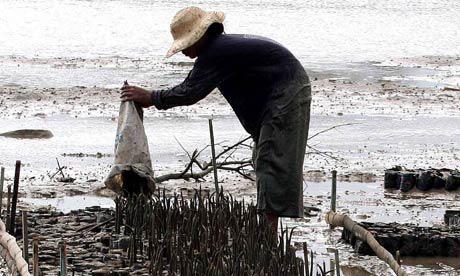
 Last week we wrapped up the topic of biodiversity within rainforests and looked at what characteristics of rainforests make them particularly vulnerable. We also discussed the issue of responsibility for the rainforest- who should share the responsibility of protecting it and why. We continued our discussion about biodiversity by looking at mangroves in order to prepare for our trip to Watamu. We looked at some key vocabulary terms and the parts of a mangrove tree and looked at some metaphors to illustrate it's functions. Next we will tackle why mangroves are under threat- as a warm-up, take a look at the situation of a mangrove forest in Asia here. Remember that your research homework on rainforest organizations is due on Tuesday- no exceptions.
Thursday, May 31, 2012
Mighty Mangroves
Last week we wrapped up the topic of biodiversity within rainforests and looked at what characteristics of rainforests make them particularly vulnerable. We also discussed the issue of responsibility for the rainforest- who should share the responsibility of protecting it and why. We continued our discussion about biodiversity by looking at mangroves in order to prepare for our trip to Watamu. We looked at some key vocabulary terms and the parts of a mangrove tree and looked at some metaphors to illustrate it's functions. Next we will tackle why mangroves are under threat- as a warm-up, take a look at the situation of a mangrove forest in Asia here. Remember that your research homework on rainforest organizations is due on Tuesday- no exceptions.
Tuesday, May 22, 2012
The Value of Rainforests
Today we continued our study of biodiversity by looking into the cultivation practices in rainforests and we posed the question- are they sustainable or not? We all know rainforests are valuable as a resource which is why we work to conserve it constantly. The responses to the questions on worksheet you received in class will be collected as a homework, so please ensure your answers to the questions are clearly written in your exercise book- the worksheet with links to the websites can be found here.
 The Transoceanic highway opened to public vehicles earlier this year. There are many concerns about how the construction of this highway will impact its surroundings since it partially runs through the heart of the amazon rainforest. Find out how scientists are measuring these impacts here.
On Thursday, we will be discussing the article read in class today and also why rainforests are so vulunterable. We plan to move to Mangroves and biodiversity next to prepare for our Watamu trip. See you Thursday.
 The Transoceanic highway opened to public vehicles earlier this year. There are many concerns about how the construction of this highway will impact its surroundings since it partially runs through the heart of the amazon rainforest. Find out how scientists are measuring these impacts here.
On Thursday, we will be discussing the article read in class today and also why rainforests are so vulunterable. We plan to move to Mangroves and biodiversity next to prepare for our Watamu trip. See you Thursday.
Tuesday, April 24, 2012
Saturday, March 17, 2012
How did biodiversity come about?

Today in class we talked about how evolution has contributed to biodiversity. The formation of new species is called speciation and this occurs through EVOLUTION. Natural Selection is a mechanism for evolution as we discussed. Check out this website for more explanations on speciation.
Friday, March 16, 2012
Biodiversity Hotspots

Here's a bit more about biodiversity hotspots- Kenya, Tanzania, and Uganda are located in what the call the Easter Afromontane hotspots. Also, it the website states the exact definition of a hot spot which includes species abundance and presence of endemic species as we discussed, but also note that the area will be considered a hot spot if it has lost at least 70% of its habitat. Check out more on this website about hotpot statistics, an interactive map, and conservation efforts.
Saturday, March 10, 2012
EIA's for Lamu and London Olympics
Our discussion in class this past Thursday and Friday was all about Environmental Impact Assessments. There are 2 developments coming up quickly that require such documents to provide evidence that they are going to have as little impact as possible on the social, environmental, and economic factors in their respective areas.

The London 2012 Olympics has produced their EIAs and they are available online through a simple search
Did you know.... The Lamu port is proceeding with construction without having an EIA completed?
Why do you think this is the case and is it ethical?

The London 2012 Olympics has produced their EIAs and they are available online through a simple search
Did you know.... The Lamu port is proceeding with construction without having an EIA completed?
Why do you think this is the case and is it ethical?
Thursday, March 8, 2012
Thursday, March 1, 2012
Discovering new organisms- through Taxonomy!
They aren't worms or even snakes. They're soil-burrowing, limbless amphibians, and they're completely new to science, a new study suggests. Read more on National Geographic

Match-tip tiny, Brookesia micra (juvenile pictured) is the smallest of four new chameleon species found on the African island country of Madagascar. With an average adult length of just over an inch (2.9 centimeters) from snout to tail, B. micra is among the tiniest reptiles in the world. Read more here

Discovered on an island off the coast of Madagascar, the newfound plant grows up to 5 feet (1.5 meters) high and blooms once a year with a "really foul" stench, according to discoverer Greg Wahlert, a postdoctoral researcher in botany at the University of Utah. Read more here


Match-tip tiny, Brookesia micra (juvenile pictured) is the smallest of four new chameleon species found on the African island country of Madagascar. With an average adult length of just over an inch (2.9 centimeters) from snout to tail, B. micra is among the tiniest reptiles in the world. Read more here

Discovered on an island off the coast of Madagascar, the newfound plant grows up to 5 feet (1.5 meters) high and blooms once a year with a "really foul" stench, according to discoverer Greg Wahlert, a postdoctoral researcher in botany at the University of Utah. Read more here

Tuesday, February 28, 2012
Sampling biotic factors in the field
Here is the lesson we started last Thursday. This week we will be looking at putting these sampling methods into practice and also using the Lincoln Index and Simpson's Diversity Index. This section corresponds to pgs 309-318 in your book.
Thursday, February 23, 2012
Is South Africa addicted to coal?
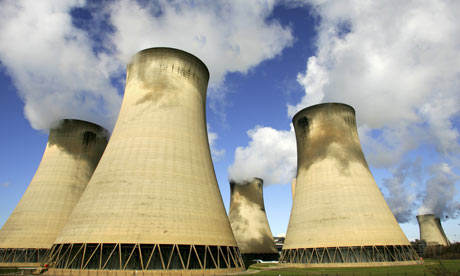
Coal is the new gold in South Africa -- it's also one of the worst polluters on the planet.
South Africa is the world's fourth largest coal exporter with over 40 billion tons of the fossil fuel in reserves, according to the government. While the Chamber of Mines reported sales of some $10 billion last year. Read more on cnn.com
Measuring Biotic Components of an Ecosystem
Today in class we learned about the importance of measuring biotic (living organisms) in an ecosystem. We investigated the science of taxonomy-classification of organisms and discussed how each organism is named using bionomial nomenclature- 2 names in latin that are of the organisms genus and species. For more information on taxonomy- I found this great website produced by Michigan State University. We also looked at the Red-Cheeked Cordon Bleu, a songbird that lives right here on our campus- here is the powerpoint so you can see how it got it's classification:
Thursday, February 9, 2012
Going green- in style or in good intentions?

Kenya's Daily Nation newspaper discusses why people "go green"- do you think they change their practices because it's trendy or do people really care about the cause? Check out this article from the nation.
Subscribe to:
Posts (Atom)